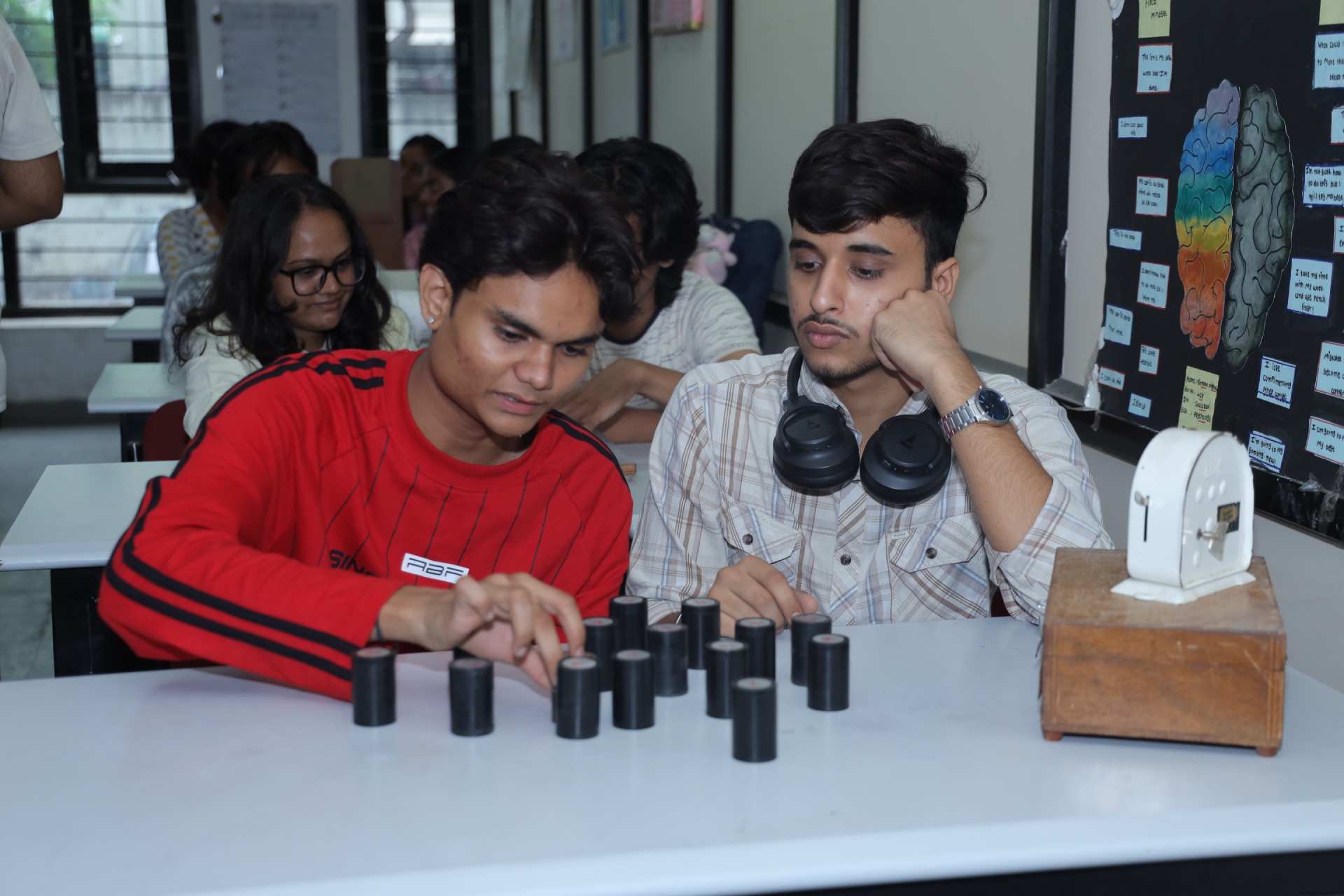

The Department of Psychology has a distinguished history spanning nine decades, having been introduced in 1937, the year when L.D. Arts College was established. Since its inception, the department has emerged as one of the most dynamic and intellectually enriching centres of the college, known for its commitment to academic excellence, scientific inquiry, and the holistic development of students.
Over the years, the department has played a vital role in shaping generations of learners by fostering an understanding of human behaviour, mental processes, and psychological well-being. It emphasizes the development of critical thinking, research aptitude, emotional intelligence, and social responsibility among students.
Established with the vision of promoting psychology as a scientific discipline and as a means to understand individuals and society, the department began its journey with dedicated faculty members and enthusiastic learners. Today, it has evolved into a vibrant academic space recognized for its scholarly contributions, innovative teaching methodologies, and strong foundation in both theoretical and applied psychology.
The strength of the department lies in its committed and highly qualified faculty, who inspire students through their passion for teaching, research, and psychological practice. Classrooms are designed to encourage interactive learning, critical analysis, and experiential understanding, where theories are explored in relation to real-life situations.
The department has consistently maintained an excellent academic record, with students achieving university ranks and distinctions. Its alumni have established successful careers as psychologists, counsellors, academicians, researchers, human resource professionals, and practitioners in diverse fields, reflecting the strong academic and ethical foundation provided by the department.
The Department of Psychology actively organizes seminars, workshops, guest lectures, counselling awareness programmes, field visits, and research-based activities. These initiatives help students develop practical skills, professional competence, and a deeper understanding of psychological applications in everyday life.
The department strongly encourages research and scientific inquiry. Faculty members contribute through publications, conferences, and research projects, while students are motivated to engage in research work, case studies, and field-based learning.
Beyond academics, the department contributes significantly to the social and emotional well-being of the college community by promoting mental health awareness, counselling initiatives, and life skills education. It enables students to understand diverse human experiences across developmental stages, cultures, and social contexts.
As it continues its journey, the Department of Psychology honours its rich legacy while embracing modern pedagogical approaches, digital tools, and interdisciplinary perspectives. With a firm belief in the transformative power of psychological knowledge, the department remains committed to nurturing reflective thinkers, compassionate individuals, and responsible global citizens.
The Department of Psychology thus stands not merely as a centre for academic learning, but as a space where the scientific understanding of human behaviour and mental processes is integrated with meaningful real-world applications across diverse personal, professional, and community contexts.
|
Program Code
|
Name of the Program Outcome
|
Program Outcomes
|
|---|---|---|
|
PO1
|
Psychological Knowledge
|
Demonstrate understanding of fundamental concepts, theories, and principles in various areas of psychology.
|
|
PO2
|
Understanding Human Behaviour
|
Explain human behaviour and mental processes using scientific and psychological perspectives.
|
|
PO3
|
Critical Thinking
|
Apply critical and analytical thinking to evaluate psychological concepts, research findings, and real-life issues.
|
|
PO4
|
Communication Skills
|
Communicate psychological ideas effectively through written, oral, and interpersonal modes.
|
|
PO5
|
Research Skills
|
Demonstrate basic research skills including research design, data collection, analysis, and interpretation.
|
|
PO6
|
Application of Psychology
|
Apply psychological principles in areas such as education, health, counselling, and organizational settings.
|
|
PO7
|
Ethical Awareness
|
Understand and follow ethical principles in psychological practice and research.
|
|
PO8
|
Emotional Intelligence
|
Develop self-awareness, empathy, and emotional regulation in personal and professional contexts.
|
|
PO9
|
Social Sensitivity
|
Demonstrate awareness of social issues, diversity, and cultural differences in understanding behaviour.
|
|
PO10
|
Mental Health Awareness
|
Promote mental health, well-being, and psychological resilience in individuals and communities.
|
|
PO11
|
Lifelong Learning
|
Develop an interest in continuous learning and professional growth in psychology.
|
|
PO12
|
Employability Skills
|
Acquire skills relevant for careers in counselling, education, research, HR, and allied fields.
|
|
Year
|
Semester
|
Course Type (Credits)
|
||||||
|---|---|---|---|---|---|---|---|---|
|
1st Year
|
Sem-I
|
Major-1
(4)
|
Major-2
(4)
|
Minor-1
(4)
|
MDC-1
(4)
|
AEC-1
(2)
|
SEC-1
(2)
|
IKS-1
(2)
|
|
Sem-II
|
Major-3
(4)
|
Major-4
(4)
|
Minor-2
(4)
|
MDC-2
(4)
|
AEC-2
(2)
|
SEC-2
(2)
|
VAC-
1
(2)
|
|
|
2 nd Year
|
Sem-III
|
Major-5
(4)
|
Major-6
(4)
|
Major-7
(4)
|
MDC-3
(4)
|
AEC-3
(2)
|
SEC-3
(2)
|
IKS-2
(2)
|
|
Sem-IV
|
Major-8
(4)
|
Major-9
(4)
|
Major-10
(4)
|
Minor-3
(4)
|
AEC-4
(2)
|
SEC-4
(2)
|
VAC-
2
(2)
|
|
|
3rd Year
|
Sem-V
|
Major-11
(4)
|
Major-12
(4)
|
Major-13
(4)
|
Minor-4
(4)
|
Minor-5
(4)
|
SEC-5
(2)
|
-
|
|
Sem-VI
|
Major-14
(4)
|
Major-15
(4)
|
Major-16
(4)
|
Minor-6
(4)
|
AEC-5
(2)
|
Internship
(4)
|
-
|
|
|
4th Year
|
Sem-VII
|
Major-17
(4)
|
Major-18
(4)
|
Major-19
(4)
|
Minor-7
(4)
|
-
|
OJT/RP-1
(6)
|
-
|
|
Sem-VIII
|
Major-20
(4)
|
Major-21
(4)
|
Major-22
(4)
|
Minor-8
(4)
|
-
|
OJT/RP-2
(6)
|
-
|
|
|
Program Code
|
Name of the Program Outcome
|
Program Outcomes
|
|---|---|---|
|
CO1
|
Understanding Basic Concepts
|
Identify and understand fundamental concepts, theories, and branches of psychology.
|
|
CO2
|
Behaviour Analysis
|
Explain and analyze human behaviour and mental processes in everyday contexts.
|
|
CO3
|
Research Awareness
|
Understand basic research methods and scientific approaches in psychology.
|
|
CO4
|
Application Skills
|
Apply psychological principles to real-life situations such as learning, motivation, and emotion.
|
|
CO5
|
Terminology and Concepts
|
Use psychological terminology and concepts accurately in academic contexts.
|
|
CO6
|
Communication Skills
|
Express psychological ideas effectively through discussions, presentations, and written work.
|
|
CO7
|
Personal Development
|
Develop understanding of various stages of human development.
|
|
Program Code
|
Name of the Program Outcome
|
Program Outcomes
|
|---|---|---|
|
CO1
|
Understanding Basic Concepts
|
Identify and understand fundamental concepts, theories, and branches of psychology.
|
|
CO2
|
Behaviour Analysis
|
Explain and analyze human behaviour and mental processes in everyday contexts.
|
|
CO3
|
Research Awareness
|
Understand basic research methods and scientific approaches in psychology.
|
|
CO4
|
Application Skills
|
Apply psychological principles to real-life situations such as learning, motivation, and emotion.
|
|
CO5
|
Terminology and Concepts
|
Use psychological terminology and concepts accurately in academic contexts.
|
|
CO6
|
Communication Skills
|
Express psychological ideas effectively through discussions, presentations, and written work.
|
|
CO7
|
Personal Development
|
Develop understanding of various stages of human development.
|
| SR NO | Particulars | BA I | BA II | BA III | BA IV | BA V | BA VI | ||||||
|---|---|---|---|---|---|---|---|---|---|---|---|---|---|
| BOY | GIRL | BOY | GIRL | BOY | GIRL | BOY | GIRL | BOY | GIRL | BOY | GIRL | ||
| 1 | Tuition Fee | 600 | - | 600 | - | 600 | - | 600 | - | 600 | - | 600 | - |
| 2 | Exam & Stationery Fee | 100 | 100 | 100 | 100 | 100 | 100 | 100 | 100 | 100 | 100 | 100 | 100 |
| 3 | Library Fee | 25 | 25 | 25 | 25 | 25 | 25 | 25 | 25 | 25 | 25 | 25 | 25 |
| 4 | Gymkhana Fee | 20 | 20 | 20 | 20 | 20 | 20 | 20 | 20 | 20 | 20 | 20 | 20 |
| 5 | Identity Card Fee | 15 | 15 | - | - | 15 | 15 | - | - | 15 | 15 | - | - |
| 6 | Student Welfare Fee | 20 | 20 | 20 | 20 | 20 | 20 | 20 | 20 | 20 | 20 | 20 | 20 |
| 7 | Cultural Activities Fee | 40 | 40 | 40 | 40 | 40 | 40 | 40 | 40 | 40 | 40 | 40 | 40 |
| 8 | Uni.work Book/union | - | - | - | - | - | - | - | - | - | - | - | - |
| 9 | Univ Sports Fee | 10 | 10 | 10 | 10 | 10 | 10 | 10 | 10 | 10 | 10 | 10 | 10 |
| 10 | Admission Fee / E N V Fee | 100 | 100 | 100 | 100 | - | - | - | - | - | - | - | - |
| 11 | Univ.medical Fee | 25 | 25 | - | - | - | - | - | - | - | - | - | - |
| 12 | Univ.enrol/regist.fee | 125 | 125 | - | - | - | - | - | - | - | - | - | - |
| 13 | Examination Fee | 500 | 500 | 500 | 500 | 250 | 250 | 250 | 250 | 250 | 250 | 250 | 250 |
| 14 | W.d.c Fee | 10 | 10 | 10 | 10 | 10 | 10 | 10 | 10 | 10 | 10 | 10 | 10 |
| Total | 1590 | 990 | 1425 | 825 | 1090 | 490 | 1075 | 475 | 1090 | 490 | 1075 | 475 | |