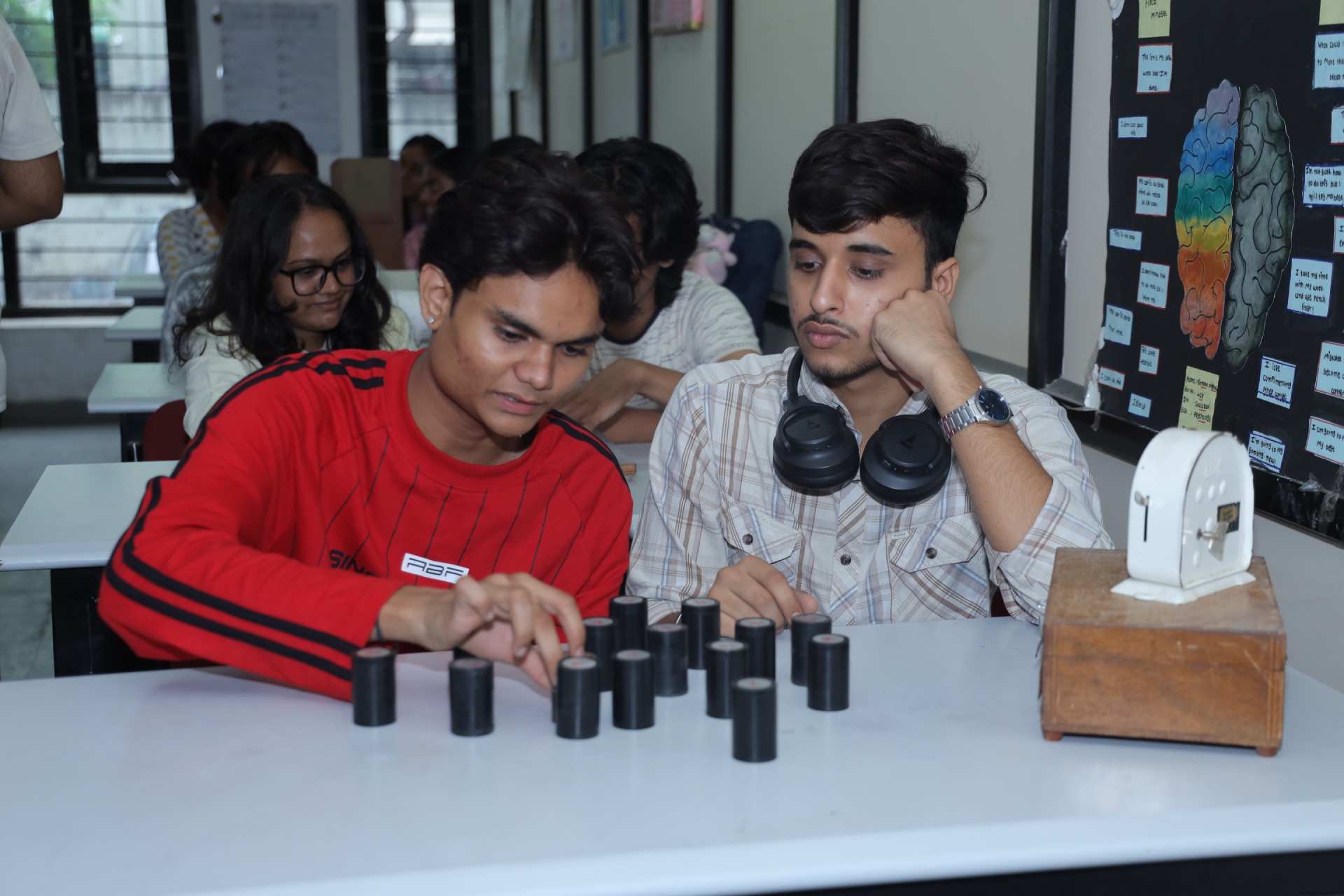

The Department of Economics was established in the year 1937. It is one of the biggest departments of the college. The department runs both UG(EM/GM) and PG(GM) programmes.
The department stands as a distinguished centre of academic excellence, intellectual inquiry, and analytical thought, with a legacy rooted in a deep commitment to understanding the complexities of economic systems. Since its establishment, the department has played a pivotal role in shaping generations of students by equipping them with the tools to interpret, analyse, and respond to the dynamic forces that govern economies at local, national, and global levels.
Founded with the vision of fostering a comprehensive understanding of economic principles and their real-world applications, the department has consistently nurtured a culture of critical thinking, empirical research, and policy-oriented learning. It aims to develop economically informed individuals who are capable of contributing meaningfully to society, governance, business, and academia.
Over the years, the department has evolved into a vibrant academic space characterized by its innovative teaching methodologies, interdisciplinary approach, and strong emphasis on both theoretical and applied economics. The curriculum is thoughtfully designed to bridge the gap between classical economic theories and contemporary economic challenges, enabling students to develop a nuanced understanding of issues such as development, globalization, sustainability, financial systems, and public policy.
The true strength of the Department of Economics lies in its highly qualified and dedicated faculty members, whose passion for teaching and research creates an intellectually stimulating learning environment. Their classrooms are centres of active engagement, where students are encouraged to question assumptions, interpret data, and engage in meaningful discussions on pressing economic issues. Through their mentorship, students are guided not only toward academic achievement but also toward becoming responsible and informed decision-makers.
The department has consistently maintained an excellent academic record, with students achieving commendable results and securing positions in prestigious institutions and professional domains. Its alumni have excelled in diverse fields including academia, public administration, banking, finance, research, consultancy, and corporate sectors, reflecting the strong analytical and ethical foundation imparted during their academic journey.
The Department was once illuminated by the great scholars and luminaires like Dr.V. K. R. V. Rao (Member of the planning commission of GOI), Prof. Chimanbhai Patel (Ex. CM of Gujarat State), Prof. Laliwala Sir (A renowned Economist), Prof. Ramesh Bhatt (A Gandhian Economist and Writer), Prof. Balkrishna Muley (A Great scholar and Writer) and Prof. A. U. Patel (Former VC of Gujarat University).
Beyond academics, the Department of Economics has consistently demonstrated its commitment to academic enrichment and contemporary relevance by organizing numerous state and national-level workshops each year. These workshops are thoughtfully designed to address pressing and emerging economic issues, thereby bridging the gap between theoretical knowledge and real-world application. Over the years, the department has successfully conducted sessions on diverse and significant themes such as the Union Budget and its implications, the concept and impact of De-dollarisation, challenges and opportunities in the Share market, the practical usefulness of mathematical economics, Effects of Tariff war on Indian economy, and critical concerns related to sustainable development and government policies. These initiatives provide students with valuable exposure to current economic discourse, enhance their analytical perspectives, and create a dynamic platform for interaction with experts, policymakers, and academicians.
The Department of Economics also places a strong emphasis on research and innovation. Faculty members contribute extensively to academic literature through publications and research projects, while students are encouraged to undertake research assignments, data analysis, and field studies that enhance their analytical and interpretative abilities.
As it moves forward, the department continues to embrace modern pedagogical practices, digital tools, and data-driven approaches, while remaining deeply rooted in its academic traditions. With a steadfast belief in the transformative power of economic knowledge, the department is committed to nurturing socially conscious, analytically sound, and globally competent individuals.
The Department of Economics thus serves not merely as a centre for academic learning, but as a platform where ideas are shaped, policies are understood, and futures are envisioned.
|
Program Code
|
Name of the Program Outcome
|
Program Outcomes
|
|---|---|---|
|
PO1
|
Basic Conceptual Knowledge of Economics
|
Develop a comprehensive understanding of various definitions of Economics, major theories, and their practical implication in local, national and international markets.
|
|
PO2
|
Analytical Ability
|
Apply critical thinking and analytical skills to interpret definition, theories and data with current issues in the context of historical economic events.
|
|
PO3
|
Presentation Skills
|
Exhibit strong analytical and presentational skills, useful in academic, professional, and social interactions through various lectures, seminars, and workshops.
|
|
PO4
|
Research Aptitude
|
Demonstrate basic research skills including theoretical and data analysis, use of econometrics, field works and surveys.
|
|
PO5
|
Enhancement of Presentational Skills
|
Express ideas creatively through various forms of research writing, sample survey and project work.
|
|
PO6
|
Spread of Digital Literacy
|
Use digital tools, online resources, and technology effectively for learning and research activities.
|
|
PO7
|
Employability Skills
|
Acquire transferable skills such as problem-solving, teamwork, time management, and adaptability relevant for careers in teaching, mass journalism, management, data interpretation, policy formation, civil services, and corporate sectors.
|
|
PO8
|
Ethical and Human Values
|
Develop empathy, ethical awareness and social responsibility through engagement with societal issues.
|
|
PO9
|
Lifelong Learning
|
Cultivate intellectual curiosity and a strong inclination towards lifelong learning through continuous reading, analysis, debates and discussions.
|
|
PO10
|
Global Perspective
|
Understand subject as a reflection of global issues, enabling students to develop a broader world view with specific emphasis on fiscal and economic perspectives.
|
|
Year
|
Semester
|
Course Type (Credits)
|
||||||
|---|---|---|---|---|---|---|---|---|
|
1st Year
|
Sem-I
|
Major-1
(4)
|
Major-2
(4)
|
Minor-1
(4)
|
MDC-1
(4)
|
AEC-1
(2)
|
SEC-1
(2)
|
IKS-1
(2)
|
|
Sem-II
|
Major-3
(4)
|
Major-4
(4)
|
Minor-2
(4)
|
MDC-2
(4)
|
AEC-2
(2)
|
SEC-2
(2)
|
VAC-
1
(2)
|
|
|
2 nd Year
|
Sem-III
|
Major-5
(4)
|
Major-6
(4)
|
Major-7
(4)
|
MDC-3
(4)
|
AEC-3
(2)
|
SEC-3
(2)
|
IKS-2
(2)
|
|
Sem-IV
|
Major-8
(4)
|
Major-9
(4)
|
Major-10
(4)
|
Minor-3
(4)
|
AEC-4
(2)
|
SEC-4
(2)
|
VAC-
2
(2)
|
|
|
3rd Year
|
Sem-V
|
Major-11
(4)
|
Major-12
(4)
|
Major-13
(4)
|
Minor-4
(4)
|
Minor-5
(4)
|
SEC-5
(2)
|
-
|
|
Sem-VI
|
Major-14
(4)
|
Major-15
(4)
|
Major-16
(4)
|
Minor-6
(4)
|
AEC-5
(2)
|
Internship
(4)
|
-
|
|
|
4th Year
|
Sem-VII
|
Major-17
(4)
|
Major-18
(4)
|
Major-19
(4)
|
Minor-7
(4)
|
-
|
OJT/RP-1
(6)
|
-
|
|
Sem-VIII
|
Major-20
(4)
|
Major-21
(4)
|
Major-22
(4)
|
Minor-8
(4)
|
-
|
OJT/RP-2
(6)
|
-
|
|
|
CO Code
|
Course Outcome Title
|
Course Outcomes
|
|---|---|---|
|
CO1
|
Understanding Basic Economic Concepts
|
Identification and understanding of various economic definitions, concepts and branches.
|
|
CO2
|
Economic Analysis
|
Analysis of prescribed work using appropriate economic approaches and interpret definitions, theories and the role of data in research.
|
|
CO3
|
Skills Development
|
Enhance behavioural and humanitarian competencies alongside strong analytical and professional skills to understand broader economic perspectives, fiscal policies, programmes and consumer behaviour.
|
|
CO4
|
Consumer Literacy regarding Modern Market Operations
|
Enhancement of the knowledge of modern market mechanism and structures of supply chains.
|
|
CO5
|
Familiarity with Economic Terms
|
Understand and apply important economic terms, theoretical and practical concepts with data interpretation.
|
|
CO6
|
Understanding contemporary Digital economic concept
|
Understanding concepts, enabling analysis of modern economic systems driven by technology and digital transformation.
|
|
CO7
|
Content Management and Web Development
|
Understanding various local, national and international economic problems and policies to solve.
|
| SR NO | Particulars | BA I | BA II | BA III | BA IV | BA V | BA VI | ||||||
|---|---|---|---|---|---|---|---|---|---|---|---|---|---|
| BOY | GIRL | BOY | GIRL | BOY | GIRL | BOY | GIRL | BOY | GIRL | BOY | GIRL | ||
| 1 | Tuition Fee | 600 | - | 600 | - | 600 | - | 600 | - | 600 | - | 600 | - |
| 2 | Exam & Stationery Fee | 100 | 100 | 100 | 100 | 100 | 100 | 100 | 100 | 100 | 100 | 100 | 100 |
| 3 | Library Fee | 25 | 25 | 25 | 25 | 25 | 25 | 25 | 25 | 25 | 25 | 25 | 25 |
| 4 | Gymkhana Fee | 20 | 20 | 20 | 20 | 20 | 20 | 20 | 20 | 20 | 20 | 20 | 20 |
| 5 | Identity Card Fee | 15 | 15 | - | - | 15 | 15 | - | - | 15 | 15 | - | - |
| 6 | Student Welfare Fee | 20 | 20 | 20 | 20 | 20 | 20 | 20 | 20 | 20 | 20 | 20 | 20 |
| 7 | Cultural Activities Fee | 40 | 40 | 40 | 40 | 40 | 40 | 40 | 40 | 40 | 40 | 40 | 40 |
| 8 | Uni.work Book/union | - | - | - | - | - | - | - | - | - | - | - | - |
| 9 | Univ Sports Fee | 10 | 10 | 10 | 10 | 10 | 10 | 10 | 10 | 10 | 10 | 10 | 10 |
| 10 | Admission Fee / E N V Fee | 100 | 100 | 100 | 100 | - | - | - | - | - | - | - | - |
| 11 | Univ.medical Fee | 25 | 25 | - | - | - | - | - | - | - | - | - | - |
| 12 | Univ.enrol/regist.fee | 125 | 125 | - | - | - | - | - | - | - | - | - | - |
| 13 | Examination Fee | 500 | 500 | 500 | 500 | 250 | 250 | 250 | 250 | 250 | 250 | 250 | 250 |
| 14 | W.d.c Fee | 10 | 10 | 10 | 10 | 10 | 10 | 10 | 10 | 10 | 10 | 10 | 10 |
| Total | 1590 | 990 | 1425 | 825 | 1090 | 490 | 1075 | 475 | 1090 | 490 | 1075 | 475 | |