
The Department of Statistics at L.D. Arts College, Ahmedabad, is an integral part of one of the oldest and most reputed institutions in Gujarat. L.D. Arts College was established in 1937 under the management of the Ahmedabad Education Society, with the visionary leadership of eminent personalities like Sardar Vallabhbhai Patel, Ganesh Mavlankar, and Kasturbhai Lalbhai. The college is affiliated with Gujarat University and has consistently upheld high academic standards with NAAC accreditation, reflecting its commitment to quality education.
The Department of Statistics contributes significantly to the multidisciplinary framework of the college by offering statistical education to students from diverse backgrounds such as Economics, Psychology, Political Science and Sociology. The department aims to build a strong conceptual foundation in statistics and promote its application in social science research. Over the years, it has developed as a dynamic academic unit supporting both major and subsidiary courses, aligning with modern curricular reforms and employability-oriented education.
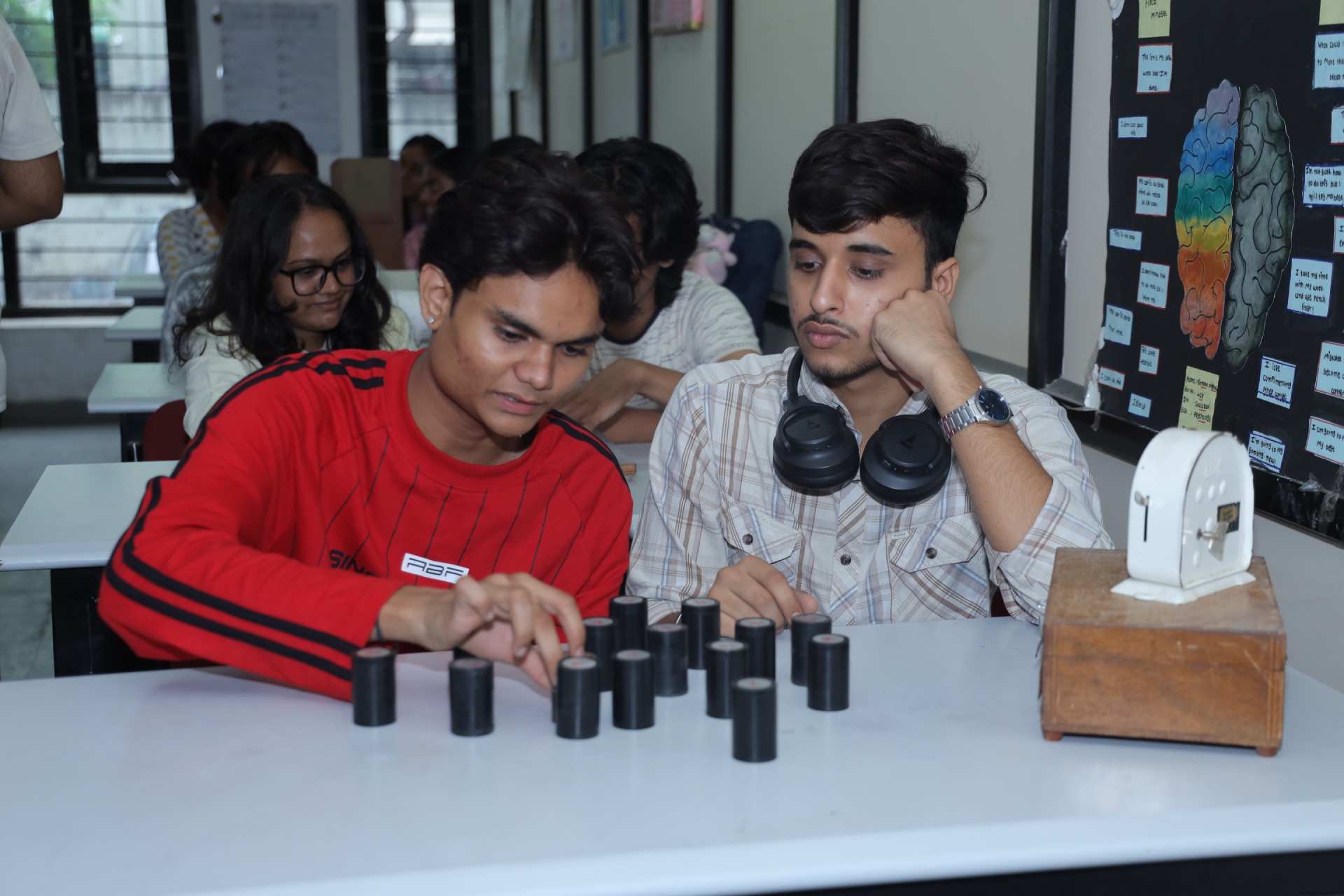
The department is supported by qualified and experienced faculty members who are dedicated to teaching, research, and academic mentoring. Faculty members actively engage students through lectures, practical sessions, workshops, and research-oriented activities. The emphasis is on developing analytical thinking, quantitative reasoning, and software-based statistical skills, thereby enhancing students’ practical exposure.
In terms of infrastructure, the department benefits from the rich academic resources of the college. The central library of L.D. Arts College is well-equipped with large collection of books, including rare collections, along with access to e-resources through INFLIBNET. Computer laboratories with internet facilities support statistical computing and data analysis. Such facilities create a conducive environment for academic excellence and research.
Student performance in the Department of Statistics has been consistently commendable. Many students secure good academic results and pursue higher studies in statistics, economics, management, and data-related fields. The college records show a substantial number of students progressing to higher education every year, reflecting strong academic grounding.
Regarding placement, while the department primarily focuses on academic and research development, the college provides placement assistance and career guidance. Various reputed organizations have been associated with campus recruitment activities. Additionally, students develop employable skills that enable them to pursue careers in data analysis, research, banking, government services, and academia.
Overall, the Department of Statistics at L.D. Arts College plays a vital role in promoting quantitative literacy and research aptitude among students. With its strong legacy, experienced faculty, rich academic resources, and focus on holistic development, the department continues to contribute effectively to higher education and the evolving demands of data-driven disciplines.
|
Program Code
|
Name of the Program Outcome
|
Program Outcomes
|
|---|---|---|
|
PO1
|
Basic Understanding of Statistics
|
Develop a strong foundation in statistical concepts and their application in social sciences.
|
|
PO2
|
Data Handling Skills
|
Collect, classify, tabulate, and present data using appropriate statistical tools.
|
|
PO3
|
Analytical Thinking
|
Apply statistical methods to analyse real-world social, economic, and psychological problems.
|
|
PO4
|
Quantitative Reasoning
|
Interpret numerical data and draw meaningful conclusions for decision-making.
|
|
PO5
|
Research Skills
|
Design and conduct basic research using statistical techniques and tools.
|
|
PO6
|
Technological Proficiency
|
Use software such as MS Excel and Jamovi for data analysis and interpretation.
|
|
PO7
|
Critical Evaluation
|
Evaluate statistical results critically and assess their relevance in policy and research contexts.
|
|
PO8
|
Problem-Solving Ability
|
Solve practical problems using probability, distributions, and inferential statistics.
|
|
PO9
|
Interdisciplinary Application
|
Integrate statistical knowledge with Economics, Psychology, and Political Science.
|
|
PO10
|
Ethical Use of Data
|
Ensure ethical handling, interpretation, and presentation of data.
|
|
Year
|
Semester
|
Course Type (Credits)
|
||||||
|---|---|---|---|---|---|---|---|---|
|
1st Year
|
Sem-I
|
Major-1
(4)
|
Major-2
(4)
|
Minor-1
(4)
|
MDC-1
(4)
|
AEC-1
(2)
|
SEC-1
(2)
|
IKS-1
(2)
|
|
Sem-II
|
Major-3
(4)
|
Major-4
(4)
|
Minor-2
(4)
|
MDC-2
(4)
|
AEC-2
(2)
|
SEC-2
(2)
|
VAC-
1
(2)
|
|
|
2 nd Year
|
Sem-III
|
Major-5
(4)
|
Major-6
(4)
|
Major-7
(4)
|
MDC-3
(4)
|
AEC-3
(2)
|
SEC-3
(2)
|
IKS-2
(2)
|
|
Sem-IV
|
Major-8
(4)
|
Major-9
(4)
|
Major-10
(4)
|
Minor-3
(4)
|
AEC-4
(2)
|
SEC-4
(2)
|
VAC-
2
(2)
|
|
|
3rd Year
|
Sem-V
|
Major-11
(4)
|
Major-12
(4)
|
Major-13
(4)
|
Minor-4
(4)
|
Minor-5
(4)
|
SEC-5
(2)
|
-
|
|
Sem-VI
|
Major-14
(4)
|
Major-15
(4)
|
Major-16
(4)
|
Minor-6
(4)
|
AEC-5
(2)
|
Internship
(4)
|
-
|
|
|
4th Year
|
Sem-VII
|
Major-17
(4)
|
Major-18
(4)
|
Major-19
(4)
|
Minor-7
(4)
|
-
|
OJT/RP-1
(6)
|
-
|
|
Sem-VIII
|
Major-20
(4)
|
Major-21
(4)
|
Major-22
(4)
|
Minor-8
(4)
|
-
|
OJT/RP-2
(6)
|
-
|
|
|
Program Code
|
Name of the Program Outcome
|
Program Outcomes
|
|---|---|---|
|
CO1
|
Basic Understanding of Statistics
|
Understand the basic concepts, scope, and importance of statistics.
|
|
CO2
|
Data Handling Methods
|
Apply methods of data collection, classification, and tabulation.
|
|
CO3
|
Data Presentation
|
Present data effectively using graphs and diagrams.
|
|
CO4
|
Descriptive Statistics
|
Compute and interpret measures of central tendency, dispersion, and skewness.
|
|
CO5
|
Time Series & Index Numbers
|
Analyse time series data and construct index numbers.
|
|
CO6
|
Demographic Methods
|
Apply demographic methods for population studies.
|
|
CO7
|
Correlation & Regression
|
Measure and interpret correlation and regression.
|
|
CO8
|
Combinatorics & Probability
|
Solve problems related to permutations, combinations, and probability.
|
|
CO9
|
Probability Distributions
|
Apply probability distributions (Binomial, Poisson, Normal) in real-life situations.
|
|
CO10
|
Hypothesis Testing
|
Perform hypothesis testing using Z-test, t-test, F-test, and Chi-square test.
|
| SR NO | Particulars | BA I | BA II | BA III | BA IV | BA V | BA VI | ||||||
|---|---|---|---|---|---|---|---|---|---|---|---|---|---|
| BOY | GIRL | BOY | GIRL | BOY | GIRL | BOY | GIRL | BOY | GIRL | BOY | GIRL | ||
| 1 | Tuition Fee | 600 | - | 600 | - | 600 | - | 600 | - | 600 | - | 600 | - |
| 2 | Exam & Stationery Fee | 100 | 100 | 100 | 100 | 100 | 100 | 100 | 100 | 100 | 100 | 100 | 100 |
| 3 | Library Fee | 25 | 25 | 25 | 25 | 25 | 25 | 25 | 25 | 25 | 25 | 25 | 25 |
| 4 | Gymkhana Fee | 20 | 20 | 20 | 20 | 20 | 20 | 20 | 20 | 20 | 20 | 20 | 20 |
| 5 | Identity Card Fee | 15 | 15 | - | - | 15 | 15 | - | - | 15 | 15 | - | - |
| 6 | Student Welfare Fee | 20 | 20 | 20 | 20 | 20 | 20 | 20 | 20 | 20 | 20 | 20 | 20 |
| 7 | Cultural Activities Fee | 40 | 40 | 40 | 40 | 40 | 40 | 40 | 40 | 40 | 40 | 40 | 40 |
| 8 | Uni.work Book/union | - | - | - | - | - | - | - | - | - | - | - | - |
| 9 | Univ Sports Fee | 10 | 10 | 10 | 10 | 10 | 10 | 10 | 10 | 10 | 10 | 10 | 10 |
| 10 | Admission Fee / E N V Fee | 100 | 100 | 100 | 100 | - | - | - | - | - | - | - | - |
| 11 | Univ.medical Fee | 25 | 25 | - | - | - | - | - | - | - | - | - | - |
| 12 | Univ.enrol/regist.fee | 125 | 125 | - | - | - | - | - | - | - | - | - | - |
| 13 | Examination Fee | 500 | 500 | 500 | 500 | 250 | 250 | 250 | 250 | 250 | 250 | 250 | 250 |
| 14 | W.d.c Fee | 10 | 10 | 10 | 10 | 10 | 10 | 10 | 10 | 10 | 10 | 10 | 10 |
| Total | 1590 | 990 | 1425 | 825 | 1090 | 490 | 1075 | 475 | 1090 | 490 | 1075 | 475 | |